Tea: A Debauve & Gallais Tradition

It all began with a story of good taste. In Paris, in the late 18th century, Sulpice Debauve had the ingenious idea of mixing his medicinal remedies with cocoa and almond milk to soften their bitterness. From this insight came a new kind of health chocolate, in the form of flat medallions called “Pistoles.” His motto: Utile Dulci—or the art of combining the useful with the pleasant.

At the same time, this explorer of flavors—a passionate enthusiast of innovation and chemistry—became interested in tea, a rare and precious commodity that was gaining popularity in Europe around that same time. After dipping cocoa into boiling water, Debauve naturally tried steeping tea leaves to bring out their aromas.

The tea company imports its finest teas from China and Ceylon by caravan and ship, before storing them in elegant black tin boxes with gold lettering.

On the flyers and chromolithographs of the time—those illustrated advertising cards that were all the rage in the 19th century—the list of sweet chocolates made with almond milk, vanilla, or Persian salep now appears alongside that of fine jasmine-flavored Chulan chocolates, Padre Souchong chocolates with smoky notes, and other delicate Pecco chocolates with white tips.

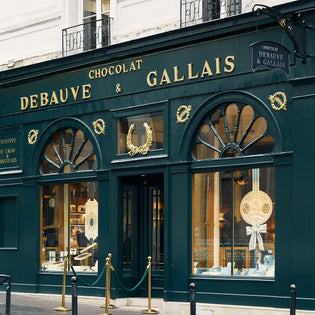
Prized for its digestive and stimulating properties, tea became popular in the salons of the aristocracy and the upper middle class, who were receptive to novelties from afar. A drink of refinement and social distinction, it was served in porcelain sets, in the afternoon or in the evening. With the evocative power of his madeleine dipped in tea, Proust turned it into a true literary motif. Prized by the Parisian elite, the store on Rue des Saints-Pères cemented its reputation as a leading establishment, offering, alongside its therapeutic chocolates, a fine selection of single-origin teas, blended teas, and herbal infusions. 

The Inheritance Claim

The entire tea collection consists exclusively of pure, unflavored teas, just as they were offered in the 19th century, staying as true as possible to the original recipes while incorporating a few contemporary touches that remain faithful to the brand’s spirit.

Sourced from the finest plantations—such as those in Lai Chau Province in Vietnam or Kagoshima Prefecture in southern Japan—the leaves are rigorously sorted to remove even the slightest imperfection. In blended teas, Madagascar vanilla, French lemon thyme, and Egyptian green anise and fennel combine with notes that range from floral to woody to malty, in proportions measured down to the milligram.

The tea selection includes Kagoshima green tea—a vegetal, iodine-tinged green tea—and Padre Souchong, a black tea from China’s Yunnan province that is traditionally smoked over beechwood in France. A few iconic blends trace the history of the house, such as the “Mélange Debauve & Gallais,” which combines Ceylon black tea with cocoa nibs and vanilla beans—the signature ingredients of their bite-sized chocolates. Floral notes dominate the “Mélange Saints-Pères,” which combines black tea from India with
s of green teas from Vietnam, scented with jasmine and lotus and accented with lavender, while a new recipe reimagines the traditional Earl Grey—dubbed “Earl Fersen”—by blending black tea from Nepal with Japanese yuzu.

Rounding out the selection, green mate from Brazil and red rooibos from South Africa offer spicy and zesty notes. The herbal teas—including “Theobroma” with cacao nibs, “Infusion des enfants” with tangy hibiscus, and “Utile Dulci” with lemon thyme, anise, and fennel—combine indulgent flavor with health benefits.

In the spirit of traditional pharmacopoeia, the collection is designed with its effects on the body and mind in mind. Key properties, ideal temperature, water quality, and steeping time are listed on each tea box. For example, the delicate jasmine Chulan—an energizing and balancing tea—is ideal for the morning and early afternoon. The Extra Blend with dark tea and tonka bean stimulates the metabolism, while the green rooibos with Japanese buckwheat is remineralizing. They can be enjoyed at teatime or to accompany dinner—served piping hot, slightly warm, or even chilled with ice cubes, in a cup or a cocktail glass.  

The double-lidded tin boxes feature the gold lettering and dark green color that are emblematic of the historic storefront of the brand. The sugarcane fiber tea bags—which contain no bleached cotton string or cardboard labels—preserve the product’s absolute purity.