History of the House

Debauve & Gallais: A Commitment to Excellence.

It all starts with a story about good taste.

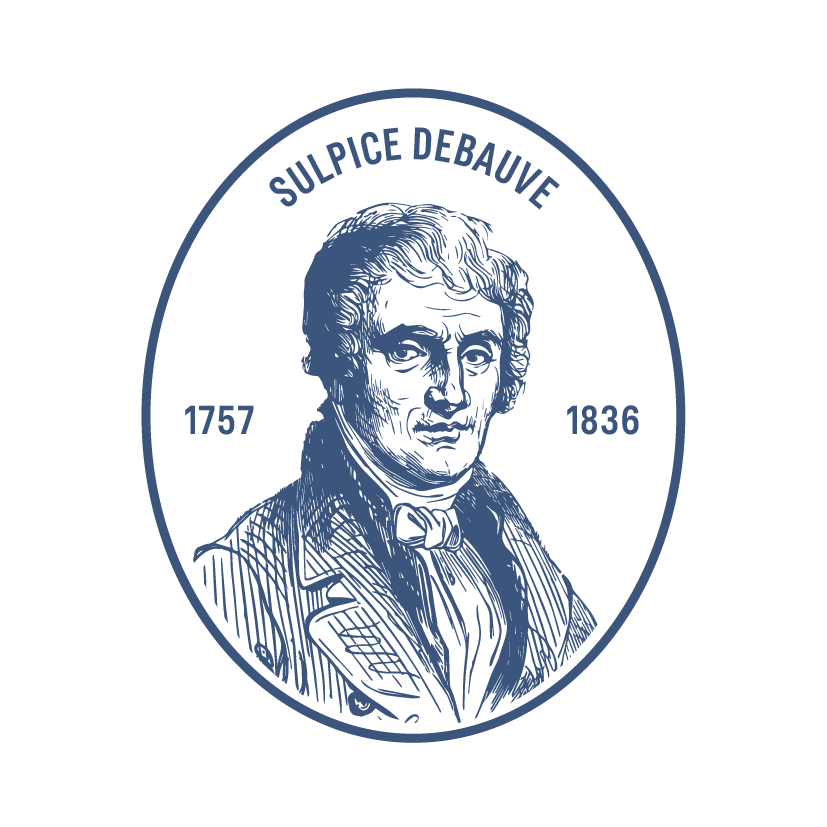
Founded in 1800 by Sulpice Debauve—the son of a doctor raised in the spirit of the Enlightenment and Louis XVI’s pharmacist at Versailles—the company combines exceptional craftsmanship, innovation, and a rigorous pursuit of balance between indulgent and health-conscious chocolates, between the useful and the pleasurable, as reflected in the founder’s motto, borrowed from Horace: Utile Dulci!

As the king’s personal pharmacist in 1779, Sulpice Debauve focused his research on cocoa. The scientist was aware of Marie Antoinette’s passion for chocolate, which reminded the Queen of France of her childhood in Vienna. Thus, to combat the sovereign’s headaches—as she complained about the bitterness of her “medicines”—he mixed the remedy with cocoa and added almond milk to sweeten the taste. The queen, delighted, named these small discs “pistoles.” Until then consumed as a beverage, Sulpice Debauve thus marked the invention of chocolate in bar form.

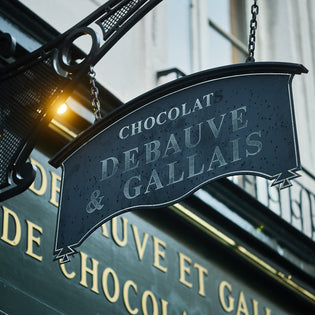
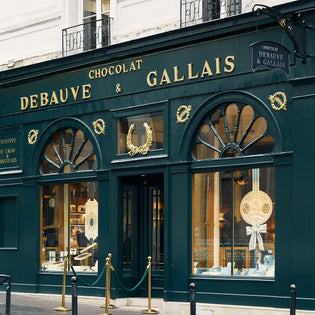
In 1800, he opened his first chocolate shop on Rue Saint-Dominique before moving, a few years later, in 1819, to Rue des Saints-Pères, into a magnificent colonnaded store designed by the architects Percier and Fontaine, which became the company’s historic headquarters.

The elegant hemicycle counter evoking an apothecary's dispensary, designed by the two fashionable decorators, and the façade, featuring Sulpice Debauve's motto "Utile Dulci", are listed as historic monuments.

Sulpice Debauve, chocolatier to First Consul Napoleon Bonaparte and later to the Emperor, created the “croquamandes” in 1807, based on an idea conceived jointly by Chef Carême and Napoleon himself. For the first time, dried fruits were coated in chocolate.

At the same time, this explorer of flavors—a passionate enthusiast of innovation and chemistry—became interested in tea, a rare and precious commodity that was gaining popularity in Europe around that same time. After dipping cocoa into boiling water, Debauve naturally tried steeping tea leaves to bring out their aromas.

The company imported its first vintage teas from China and Ceylon by caravan and ship, before storing them in elegant black tin boxes with gold lettering. On the flyers and chromolithographs of the era—those illustrated advertising cards that were all the rage in the 19th century—the list of sweet chocolates flavored with almond milk, vanilla, or Persian salep now appears alongside that of fine jasmine-scented Chulan teas, Padre Souchong teas with smoky notes, and other delicate Pecco teas with white tips.


Joined in 1823 by his nephew Jean-Baptiste Gallais, also a scientist, the company developed and distributed “health teas and chocolates.”

In *The Physiology of Taste*, a seminal work on gastronomy published in 1826, the food journalist Brillat Savarin cites the virtues of health-promoting chocolates: “Guided by the insights of a sacred doctrine, Sulpice Debauve also sought to offer his many customers pleasant remedies for certain health issues. Thus, for those who are underweight, he offers analeptic chocolate with salep; for those with delicate nerves, antispasmodic chocolate with orange blossom; to those prone to irritability, milk chocolate with sweet almonds, to which he will no doubt add ‘the chocolate for the afflicted,’ amber in color and dosed secundum artem.”

In 1820, Jean-Baptiste Gallais toured North and South America to map cocoa plantations. On his return, he carried out a rigorous classification of the farms, a work of reference published in 1825 named the "Monographie du cacao".

 In 1825, the chocolatiers Debauve & Gallais were awarded the title of purveyor to the kings of France, and created a chocolate decorated with a fleur-de-lis for the coronation of Charles X.

Among the company's many innovations, in 1838 they discovered the first milk dehydration porcess, lactoline, the basis of modern pastry-making.

A patent of this dsicovery can be seen on a private tour of the salon at the boutique on the Rue des Saints-Pères.

The numerous medals won by the founders' descendants at the World Fair (1867, 1878, 1889, and 1900) prove the company's constant drive to push back the limits of excellence and innovation without sacrificing the essential gourmet taste.

The gold medal won in 1878 at the
, the national exhibition in Antwerp, for “Eclair chocolate,” an instant chocolate mix, is a perfect example of this.

The house has weathered every crisis, resisted every change of regime, and has been celebrated by the greatest writers of their time, from Balzac and Proust to Rimbaud and Baudelaire.

."Everything at Debauve & Gallais has a style, a character, a meaning.”

This description, borrowed from the writer Anatole France, illustrates and justifies the philosophy of an institution that has embodied France for more than 220 years, and enchanted the most demanding palates. 

Like a family secret passed down from generation to generation, Debauve & Gallais—remaining as true as ever to its motto, *Utile Dulci*—invites food lovers of all ages to
and combine business with pleasure.